
A Drowning Landscape
There is a profound dread inherent to the East Anglian coastline, a sense that the land is merely on loan from the North Sea. Saltwick Marsh captures this liminal anxiety with devastating precision, delivering a third-person narrative investigation that feels as shifting and treacherous as the mudflats it depicts. Developed with an acute eye for atmospheric tension, the game eschews traditional detective tropes in favour of a methodical exploration of a community drowning in its own secrets. The player is cast into a bleak expanse where every step must be calculated, and where the environment is as much an antagonist as any hidden culprit.
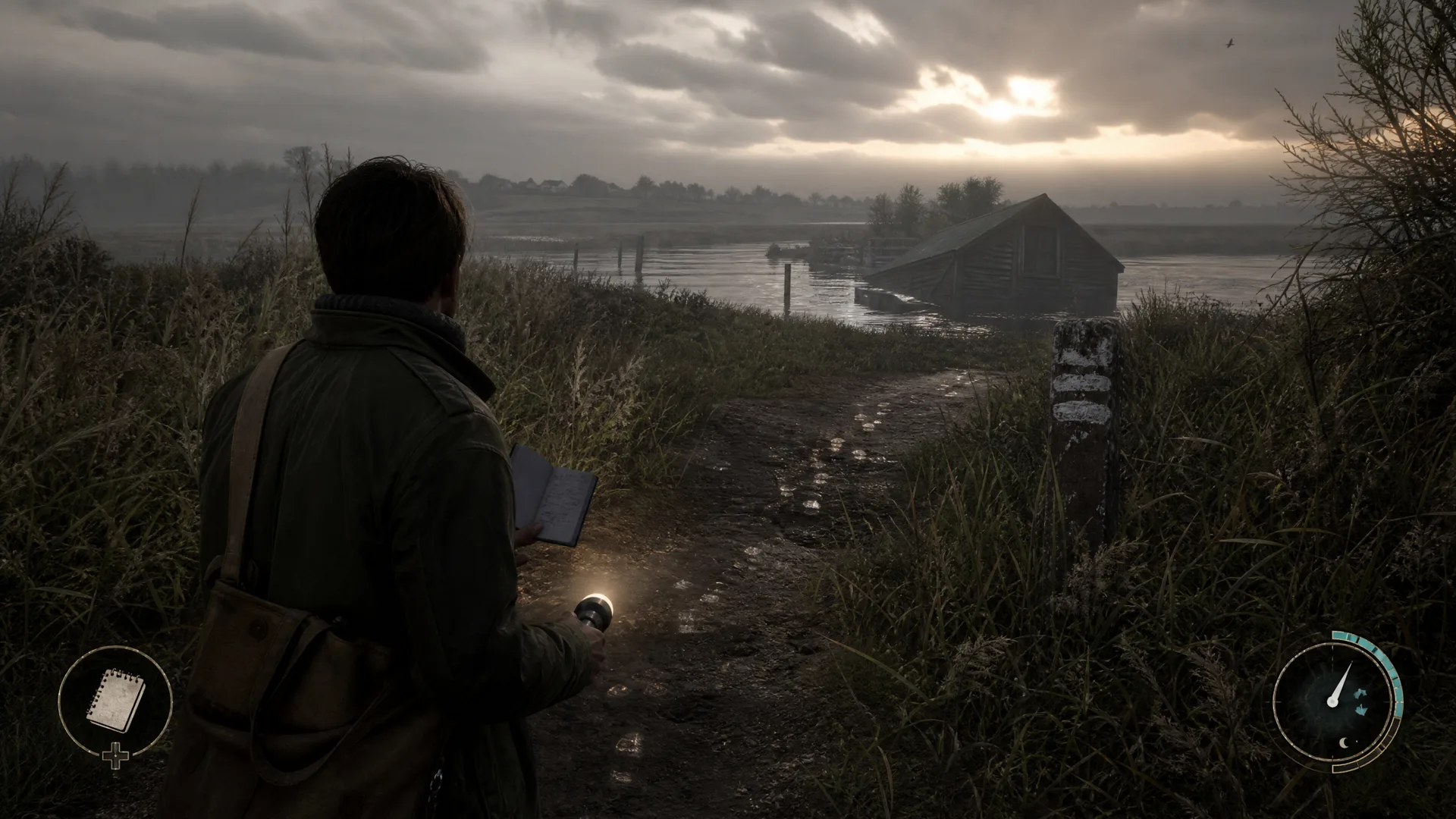
From the moment you set foot on the sodden earth, the game establishes a deliberate pace. You are an exhausted investigator relying on keen observation and a weather-beaten notebook, not a superhero armed with infallible forensic technology. The camera hovers closely over your shoulder, framing the desolate beauty of the marshland while ensuring you feel the claustrophobia of the encroaching fog.
Time and Tide Wait for No Detective
At the mechanical heart of the experience lies the ingenious implementation of the tide clock, a system dictating not just the rhythm of your investigation, but your survival. The marsh is a dynamic entity, governed by the relentless pull of the moon. Areas safely traversable at low tide become impassable, freezing depths within hours. This constant temporal pressure elevates the standard adventure formula into a tense race against nature. You find yourself constantly checking the tarnished brass clock in your inventory, calculating whether you have enough time to reach a distant farmhouse before the causeway is swallowed by the sea.
This environmental urgency ties directly into the notebook system, which serves as the central repository for your deductions. Rather than automatically updating with neat objectives, the notebook requires manual engagement. Clues must be physically jotted down, cross-referenced, and categorised. The interplay between the ticking clock and the need for careful deduction creates a deliciously stressful loop.
Illuminating the Muck
The physical act of investigating the marsh is a tactile, satisfying experience, heavily reliant on the game's nuanced tracking mechanics. Footprints in the mud are not permanently glowing breadcrumbs; they are fragile indentations that can be washed away by a sudden downpour or the incoming tide. Following a suspect's trail requires a keen eye for subtle disturbances in the reeds and the disturbed silt. This mechanical fragility forces you to pay close attention to the ground beneath your feet, transforming navigation into an active, analytical process.
When the sun dips below the horizon, the torch becomes your lifeline. The lighting engine is spectacular, casting long, menacing shadows that dance and distort with your every movement. The torch beam is narrow and its battery life finite, meaning you must use it judiciously. Sweeping the beam across a muddy embankment to catch the faint glint of a discarded key feels genuinely triumphant.
Shifting Ground and Shifting Goals
Level design in Saltwick Marsh is a masterclass in organic, non-linear architecture. Because the tide constantly reshapes the topography, your understanding of the map must remain fluid. A shortcut that saved you minutes yesterday might be a watery grave today, forcing you to find alternative routes through treacherous bogs and crumbling sea walls. This changing path system ensures that backtracking never feels like a chore. The environment is always presenting new challenges, demanding that you continuously adapt your spatial awareness to the whims of the estuary.
The game also employs a subtle approach to objective distance, stripping away the intrusive HUD markers that plague modern open-world design. Instead of a floating chevron telling you exactly where to go, you are given compass bearings, local landmarks, and vague distances estimated by uncooperative locals.
Piecing Together the Past
Investigation is only half the battle; the truth must eventually be extracted from the secretive, insular residents of the marsh. The interview mechanics are refreshingly complex, treating dialogue as a tactical encounter rather than an exposition dump. Characters are guarded, often hostile, and fiercely protective of their own. You must carefully manage your tone, using the evidence gathered in your notebook to press for details without alienating your subject.
When the physical evidence and the testimonies align, the game introduces its most visually striking mechanic: environmental reconstruction. By piecing together a timeline of events, the player can trigger a stylized, ghostly overlay that projects the hypothesized sequence of events onto the current environment. These reconstructions are not infallible; they are only as accurate as the deductions you have made. If you have misinterpreted a footprint or believed a lying witness, the reconstruction will fail to align with the physical reality of the scene.
The Rhythm of the Estuary
Pacing is a notoriously difficult element to balance in narrative-heavy games, but this title handles its tempo with the grace of a seasoned novelist. The narrative breathes, allowing for moments of quiet, melancholic contemplation amidst the tense investigative sequences. There are stretches where your only company is the howling wind and the cry of seagulls, providing necessary downtime to process the complex web of relationships and alibis you are unravelling.
The structure of the mystery itself is equally well-paced, peeling back layers of deceit with measured precision. The game resists the urge to rush towards explosive set-pieces, instead building tension through the slow, steady accumulation of damning facts. Every new revelation feels earned, the result of your own hard work rather than a scripted plot contrivance.
A Masterclass in Bleak Beauty
From a presentation standpoint, the game is a triumph of art direction over sheer graphical fidelity. While the textures of the mud and the water are impressively realistic, it is the cohesive, oppressive atmosphere that truly stands out. The colour palette is dominated by bruised purples, sickly greens, and slate greys, perfectly capturing the damp, bone-chilling reality of the English coast in late autumn.
To ensure this bleak beauty is widely playable, the developers have included a robust suite of technical and accessibility options:
- Performance on current-generation hardware is remarkably stable, maintaining a smooth framerate even during complex water physics simulations.
- High-contrast modes are thoughtfully integrated for the visually impaired without breaking the atmospheric immersion.
- The option to adjust the speed of the tide clock provides relief for those who find the temporal pressure too punishing.
The Verdict on the Mudflats
Saltwick Marsh is a rare achievement in the investigative genre, a game that trusts its players to be intelligent, observant, and patient. By intertwining its narrative so tightly with its mechanics, it creates an experience where the act of deduction feels genuinely dangerous and profoundly rewarding. The shifting landscape, the ticking tide clock, and the complex interview systems all work in perfect harmony to simulate the exhausting, thrilling reality of uncovering the truth.
It is a game that will linger in your thoughts long after you have closed your notebook and escaped the rising waters. The East Anglian marsh has been rendered not just as a backdrop, but as a living, breathing adversary, a keeper of secrets that yields its answers only to those willing to wade deep into the muck. For players seeking a mature, uncompromising mystery that respects their intellect and challenges their deductive skills, this is an essential journey into the dark heart of the British coastline.