
A Damp Evening in the Midlands
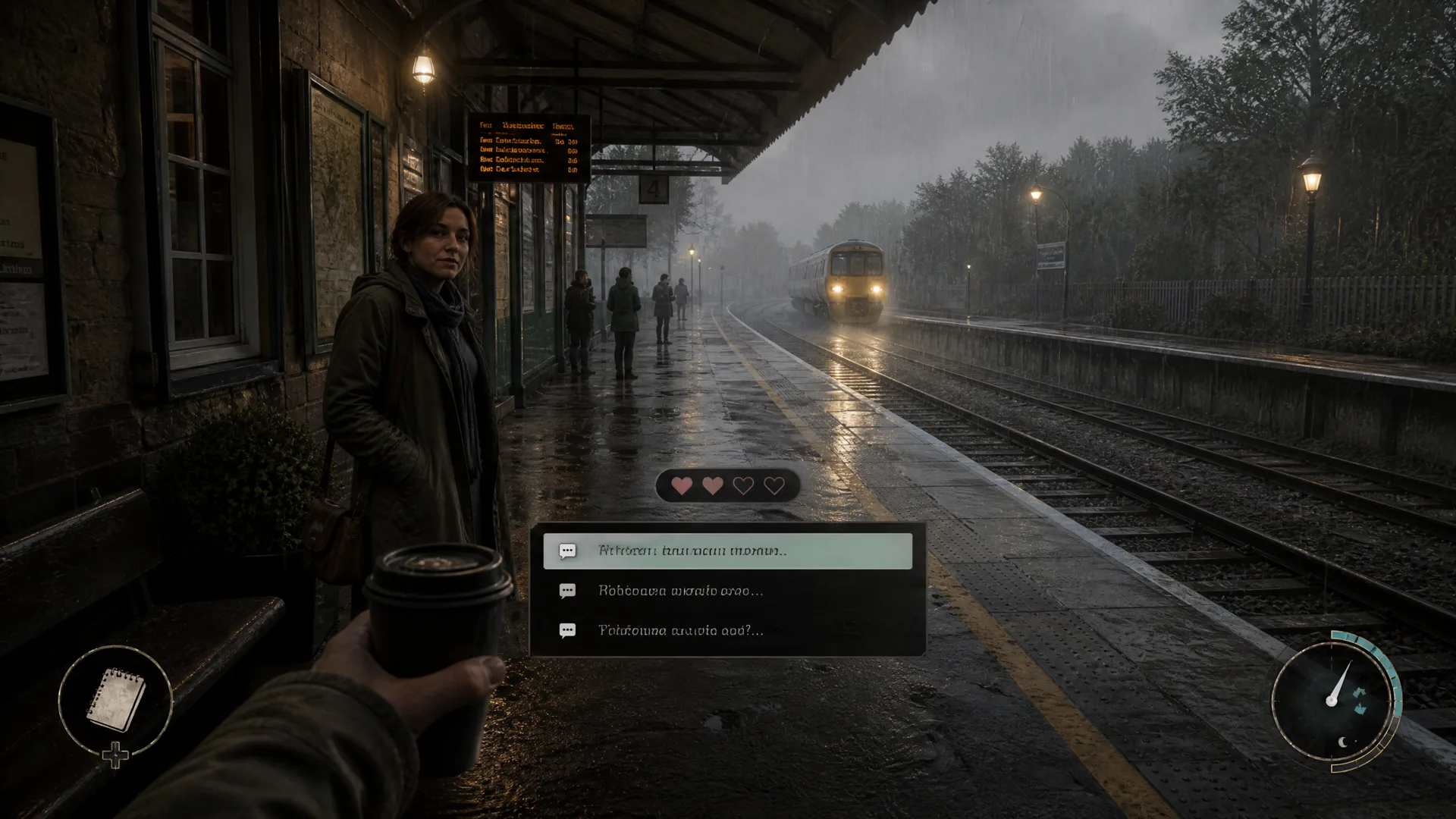
There is a specific sort of melancholy that clings to a British regional railway station on a Tuesday evening in November. The drizzle falls with a steady, unhurried persistence, slicking the tarmac and turning the orange glow of the sodium lamps into blurred halos. It is precisely this atmosphere that Rain on Platform Four captures with such startling fidelity. Developed by the small team at Puddle Jumper Studios, this first-person narrative simulation strips away the grand heroics of modern gaming, replacing them with the quiet, desperate hope of a delayed commuter trying to get home.
From the moment you step onto the rain-slicked concrete, the game asserts its pacing. You are not rushing to defuse a bomb or save the world; you are simply waiting for the 19:42 to Birmingham New Street, which the digital board informs you is running approximately twelve minutes late. This delay timer becomes the central metronome of the experience, a ticking clock that dictates not when you fail, but how much time you have to unravel the small, intersecting lives of the people stranded alongside you.
The presentation is masterfully subdued. The sound design leans heavily on the rhythmic patter of rain against corrugated plastic roofing, punctuated by the tinny, apologetic crackle of the station announcer. Visually, the game employs a muted palette of greys, blues, and harsh artificial yellows, creating an environment that feels at once deeply familiar and profoundly isolating. It is a space designed for transience, yet the game forces you to inhabit it, turning a mundane wait into a compelling exploration of human connection.
The Mechanics of Conversation
At its core, Rain on Platform Four is a game about talking, or perhaps more accurately, about listening. The primary mechanic revolves around dialogue choices, but these are not the sprawling, consequence-heavy trees found in traditional role-playing games. Instead, they are subtle, nuanced interactions that reflect the delicate social dance of speaking to strangers in a public place. You might offer a sympathetic nod to a businessman furiously refreshing his phone, or share a wry comment about the weather with an elderly woman clutching a damp copy of the local paper.
These spatial conversations are intricately tied to your physical positioning on the platform. Moving too close to someone might make them clam up, reading as an intrusion of their personal space, while standing too far away means you miss the quiet muttering that initiates a deeper exchange. It is a delicate balancing act, requiring you to read the body language and spatial cues of the NPCs before engaging. This mechanic transforms the platform into a chessboard of social interaction, where every step and every glance carries weight.
The dialogue itself is beautifully written, capturing the cadence of British politeness masking underlying anxieties. You are given choices that range from the deeply empathetic to the politely dismissive, and the game does not judge you for either. Sometimes, people just want to be left alone, and learning when to walk away is as important as knowing what to say. It is a refreshing approach to narrative design, one that respects the boundaries of its characters.
Keeping Track in the Notebook
As you navigate these fleeting interactions, your primary tool is a battered notebook. This is not a magical inventory or an omniscient quest log; it is a literal representation of your character's observations. Whenever you learn a crucial piece of information—a name, a destination, a worry about a sick relative—your character hastily scribbles it down. The notebook serves as both a reference guide and a tangible record of your time on the platform.
Crucially, the notebook is entirely player-driven. You must manually choose what to record and what to ignore, a system that encourages active listening rather than passive consumption of dialogue. If the barista at the closed coffee kiosk mentions that the 20:15 train is always cancelled on Tuesdays, writing that down might save another passenger from a futile wait. The game trusts you to connect the dots, offering no glowing waypoints or intrusive hints.
This mechanic shines brightest when dealing with the game's relationship system. The connections you form are fragile and temporary, built on shared frustration and proximity. The notebook helps you keep track of these delicate bonds, allowing you to recall a detail later in a conversation to show that you were genuinely paying attention. It is a small touch, but one that adds a profound layer of intimacy to the experience.
The Tyranny of the Train Board
Looming over the entire experience is the digital train board, a flickering oracle that dictates the flow of the game. Its updates are erratic and often cruel, changing delays from ten minutes to thirty, or suddenly announcing a platform alteration that sends the waiting crowd scurrying. The board is not just a piece of set dressing; it is an active participant in the narrative, a chaotic force that disrupts conversations and forces snap decisions.
The changing board ties directly into the delay timer mechanic. You are constantly balancing the desire to finish a conversation with the need to keep an eye on your own train. Missed connections are a very real possibility in Rain on Platform Four. If you are deep in conversation at the far end of the platform when your train suddenly arrives, you might have to choose between hearing the end of a heartbreaking story and making it home before midnight.
These missed connections are not framed as failures, but as poignant narrative outcomes. The game acknowledges that life is full of unfinished business and interrupted moments. Sometimes, a conversation is cut short by the hiss of pneumatic doors, leaving you wondering what might have been said. It is a bold design choice that reinforces the game's central theme of transience and the fleeting nature of human connection.
Systems Interlocking in the Damp
What makes Rain on Platform Four so compelling is how these mechanics interlock. The delay timer forces urgency, the spatial conversations demand careful positioning, the notebook requires active engagement, and the train board introduces chaos. Together, they create a simulation that feels remarkably organic. You are not just playing through a story; you are managing a complex ecosystem of social interactions under the pressure of an unpredictable schedule.
Consider a scenario where you are trying to help a stressed student find their lost ticket. You must use the notebook to track clues gathered from other passengers, navigate the spatial boundaries of a crowded waiting room, and keep one eye on the board to ensure neither of you misses your train. It is a delicate juggling act that requires genuine empathy and situational awareness, turning a simple fetch quest into a tense, emotionally resonant experience.
The relationships you build, however brief, feel earned because they are the result of this mechanical friction. You have to work for these moments of connection, fighting against the apathy of the environment and the ticking clock. When you finally manage to offer a piece of comforting advice or share a genuine laugh with a stranger, the payoff is immensely satisfying, precisely because the game made it so difficult to achieve.
Accessibility and Performance
Given the game's reliance on reading text and interpreting subtle visual cues, accessibility is a crucial consideration. Puddle Jumper Studios has implemented a robust suite of options, including scalable text sizes, high-contrast modes for the notebook, and the ability to pause the delay timer during conversations. This last feature is particularly welcome, allowing players who need more time to process dialogue to engage with the narrative without feeling artificially rushed.
Performance on PC is generally excellent, as one would expect from a relatively contained environment. The rain effects are beautifully rendered, and the lighting dynamic reacts convincingly to the passing of trains and the flickering of the station lamps. However, there are occasional stutters when the train board updates its entire display simultaneously, a minor technical hiccup that momentarily breaks the otherwise immersive atmosphere.
It is also worth noting that the game runs flawlessly on the Steam Deck, which feels like its natural home. The intimate nature of the screen and the tactile feedback of the controls enhance the feeling of holding a notebook and peering into the lives of strangers. It is the perfect game to play on a real train journey, adding a layer of meta-narrative to the experience.
A Delay Worth Taking
Rain on Platform Four is a masterclass in constrained design. By focusing entirely on a single, mundane location and a handful of mechanics, it manages to tell a story that feels both incredibly specific and universally relatable. It captures the quiet desperation of the British commuter, the awkward beauty of public interactions, and the profound melancholy of a missed connection.
The game asks you to find meaning in the waiting, to see the people around you not as obstacles or background noise, but as individuals with their own complex lives and worries. It is a quiet, contemplative experience that lingers long after the final train has departed the station.
While its slow pace and lack of traditional action may not appeal to everyone, those willing to embrace its melancholy atmosphere will find a deeply rewarding narrative simulation. It is a reminder that sometimes, the most interesting stories are the ones happening in the margins, while we are waiting for something else to begin.
- Standout Feature: The spatial conversation system makes every interaction feel grounded and real.
- Best Moment: Sprinting for a suddenly announced train while a stranger shouts the end of their story after you.
- Minor Grievance: The train board updates can occasionally cause brief framerate drops on older hardware.