
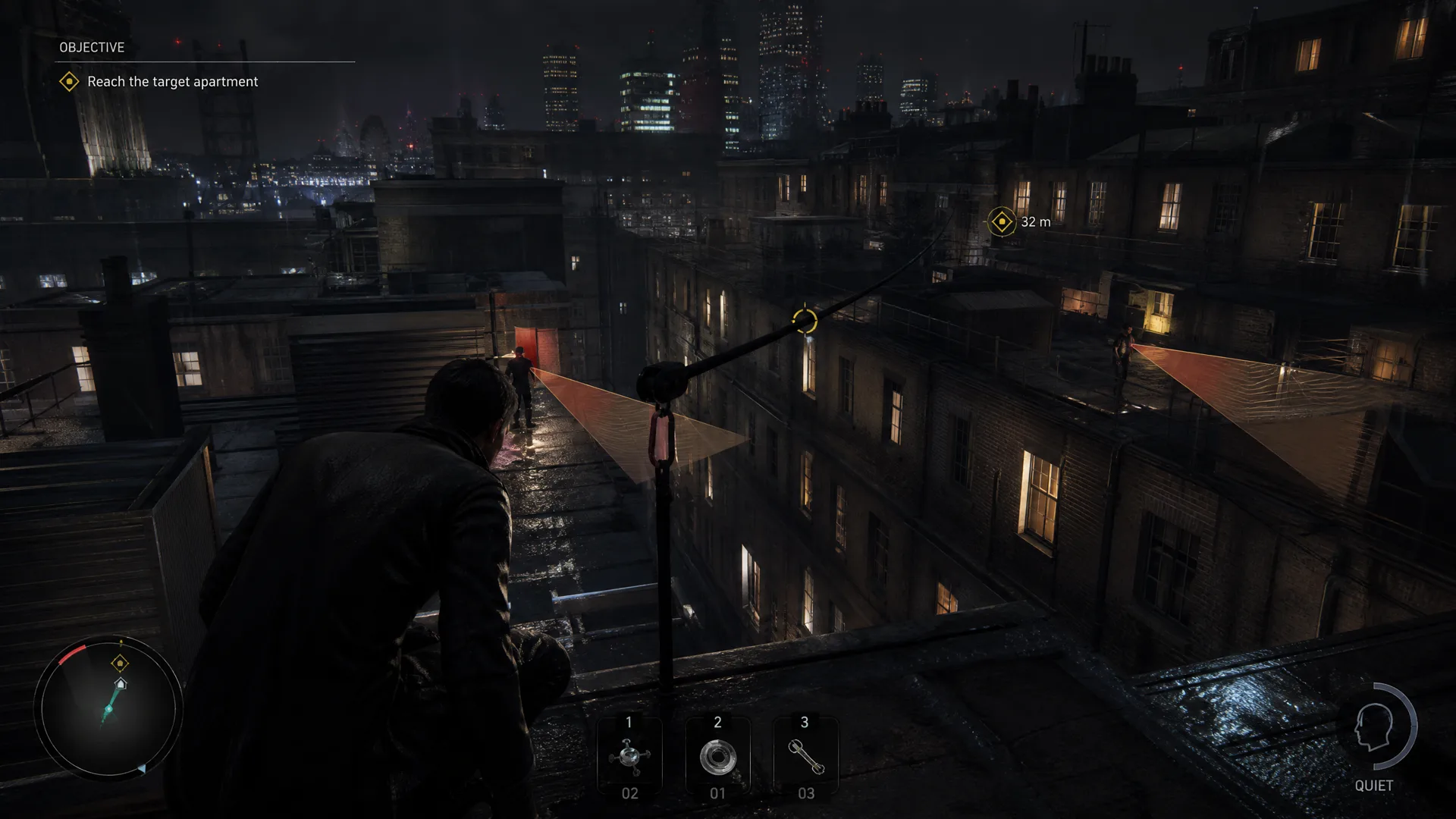
The Allure of the Rain-Slicked Skyline
There is a distinct, melancholic beauty to a London skyline drenched in persistent, freezing rain. It is within this atmospheric gloom that Night Window, the latest effort from the fictional but immensely talented studio Blackfriars Interactive, finds its footing. As a third-person urban stealth experience, the game does not merely use the sprawling metropolis as a backdrop; rather, it weaponises the city’s architecture, weather, and verticality to create a tense, methodical sandbox. Players are cast not as heavily armed commandos, but as silent observers—infiltrators who must navigate the treacherous, slippery slate of Victorian rooftops whilst remaining entirely unseen by the patrols below.
At the core of the experience lies a compelling thematic question regarding the ethics of looking in. The protagonist is tasked with gathering sensitive corporate intelligence, a mission that frequently requires peering through the illuminated windows of oblivious citizens and ruthless security personnel alike. This voyeuristic framing is uncomfortable by design, forcing the player to confront the invasive nature of their espionage.
Mastering the Shadows and the Silence
Stealth in this concrete jungle is governed by two uncompromising pillars: visibility and noise. The developers have crafted a dynamic lighting system where every flickering streetlamp, sweeping searchlight, and illuminated billboard poses a tangible threat. The player’s visibility is directly tied to the ambient light, requiring constant awareness of shadows. Darting between the silhouettes of chimney stacks and air conditioning units becomes a rhythmic dance, punctuated by the heart-stopping moments when a sudden flash of lightning threatens to expose your position.
Equally important is the soundscape. The acoustic design is remarkably sophisticated, with the persistent patter of rain masking lighter footsteps but failing to cover the heavy thud of a careless landing. Different surfaces—from the crunch of loose gravel on a flat roof to the sharp metallic clang of a fire escape—demand different approaches. The player must constantly weigh the speed of their movement against the noise it generates.
The Arsenal of the Silent Infiltrator
Whilst direct confrontation is heavily discouraged, the protagonist is equipped with a versatile array of gadgets designed for misdirection and traversal. The most prominent of these is the pneumatic zip line, a beautifully animated tool that allows for rapid, silent movement across wide gaps between buildings. Deploying the zip line requires careful consideration of anchor points and the trajectory of the cable, ensuring that the player does not inadvertently slide directly into the cone of vision of a stationed guard.
Beyond traversal, the gadget roster is focused entirely on manipulation rather than destruction. Directional microphones allow players to eavesdrop on conversations from a distance, gathering vital passcodes or identifying the locations of high-value targets. Distraction emitters can be thrown to draw guards away from critical doorways, whilst localised EMP darts can temporarily disable security cameras and electronic locks.
Through the Glass: Observation as a Mechanic
The titular mechanic of Night Window is perhaps its most innovative feature. Rather than relying on magical x-ray vision or omniscient minimaps, players must gather intelligence the old-fashioned way: by looking through windows. The game features highly detailed interior spaces that can be observed from the rooftops, ledges, and fire escapes outside. Peering through the glass is not a passive activity; it requires the player to manually adjust their focus, track moving targets, and identify points of interest within the room.
This system fundamentally alters the flow of the game. Before infiltrating a building, players are encouraged to spend time on the perimeter, mapping out the interior layout and the positions of the guards. It is during these prolonged periods of observation that the thematic weight of the narrative is most keenly felt. You are an intruder, a silent witness to the private lives and corporate machinations occurring within these illuminated boxes.
Navigating the Urban Labyrinth
The level design in Night Window is nothing short of exceptional, offering a staggering degree of verticality and freedom. Each district of the city is presented as a dense, interconnected puzzle box, filled with alternate routes and hidden pathways. A heavily guarded main entrance might be bypassed by scaling a drainpipe, traversing a crumbling parapet, and slipping through an unlocked skylight. The game actively rewards exploration, encouraging players to look beyond the obvious paths and utilise the architecture to their advantage.
This open-ended approach to objective completion is supported by the game’s robust climbing mechanics. The protagonist moves with a fluid, athletic grace, seamlessly transitioning between leaps, mantles, and ledge hangs. The controls are precise and responsive, which is absolutely vital when a single misjudged jump can result in a fatal plummet to the alleyway below.
Guard Awareness and the Anatomy of Suspicion
A stealth game is only as good as its artificial intelligence, and the guards in Night Window are refreshingly competent. They do not merely patrol on rigid, predictable loops; they react dynamically to changes in their environment. An open door that was previously closed, a missing colleague, or the sudden extinguishing of a light source will all trigger states of heightened suspicion.
The awareness system is clearly telegraphed but entirely unforgiving. A quick glimpse of the player will cause a guard to investigate the disturbance, whilst a sustained line of sight will trigger a full-blown alarm. Once alerted, the enemies are lethal, and attempting to engage them in a firefight is a guaranteed death sentence. The only viable option is to break the line of sight, utilise a distraction, and melt back into the shadows.
The Imperative of Non-Lethal Infiltration
In keeping with its themes of professional espionage and ethical boundaries, Night Window places a heavy emphasis on non-lethal objectives. The protagonist is an observer and an infiltrator, not an assassin. While it is possible to pacify guards using chokeholds or tranquilliser darts, the game actively discourages leaving a trail of unconscious bodies.
- Ghosting: Completing objectives without being seen or interacting with any guards yields the highest rewards.
- Pacification: Non-lethal takedowns are permitted but require careful hiding of the bodies in dumpsters or dark corners.
- Environmental Manipulation: Using the environment to bypass guards entirely is always preferable to direct engagement.
Presentation, Pacing, and Final Verdict
From a presentation standpoint, the game is a triumph of atmospheric design. The rendering of the rain-slicked surfaces, the harsh glare of the neon signs cutting through the fog, and the intricate details of the Victorian masonry create a world that feels incredibly tactile and grounded. The performance is largely stable, though there are occasional, minor frame-rate dips when panning across the more expansive city vistas.
The pacing, while deliberately slow, is masterful. The tension is ratcheted up incrementally, building from the quiet, methodical observation of the exterior to the nerve-wracking, claustrophobic infiltration of the interior spaces. It is an experience that demands your full attention, rewarding those who are willing to engage with its complex systems.